Knocking religion: The Book of Mormon by Garth Jones

RELIGIOUS satire has existed for millennia, pre-dating Christianity itself.

From the work of Greek playwright Aristophanes - circa 400BC -  through to last year’s ribald Seth Rogen animated comedy Sausage Party, the tradition of art questioning belief is fundamental to humanity’s ongoing spiritual evolution.

In his 2003 book A Serrated Edge: A Brief Defense of Biblical Satire, theologian Douglas Wilson reminds us that “satire is a kind of preaching… Satire treats the foibles of sinners with a less than perfect tenderness.”

Trey Parker and Matt Stone, of South Park notoriety, have ribbed religion since their early animated short, 1992’s ‘Jesus versus Frosty’. The duo could certainly be accused of “less than perfect tenderness” when it comes to their wide-ranging satirical targets. No cow is too sacred for these equal opportunity provocateurs - race, sexuality, popular culture and religion are all fair game, with everyone from bleeding hearts to conservative hard liners squarely in their sights.

The Book of Mormon - developed by Parker and Stone with Grammy-winning Avenue Q songwriter Robert Lopez - debuted on Broadway in 2011 to astonishing, ongoing success.

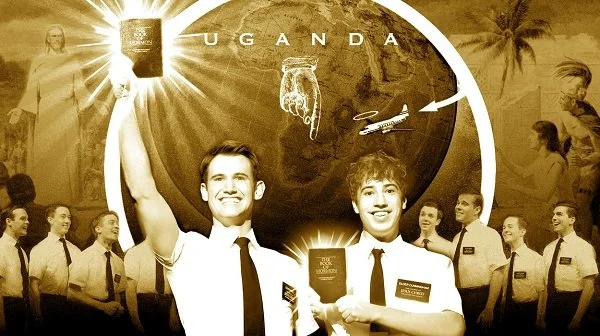
The story of two trainee Mormon missionaries - the ambitious, benignly ruthless Elder Price (Canadian Ryan Bondy channelling Trump offspring Eric) and the dorky, lonely Elder Cunningham (Broadway production transplant A.J. Holmes) - Book of Mormon continues the South Park creators’ career-long obsession with profane parody, the overblown tropes of musical theatre and ever-present scatological provocation.

The Book of Mormon follows Elders Price and Cunningham’s unexpected two year deployment to Uganda. Confronted with Third World realities - AIDS, ruthless warlords, female genital mutilation, extreme poverty - the duo of innocent Latter-Day Saints discover these issues are not easily resolved with homilies or rituals.

Drawing upon the extravagant staging, religious motifs and rock opera excesses of Tim Rice and Andrew Lloyd-Webber’s Joseph and His Amazing Technicolour Dreamcoat (1968) and Jesus Christ Superstar (1971), The Book of Mormon also expands upon themes explored in Monty Python’s notoriously banned Life of Brian (1978).

Melbourne’s Princess Theatre plays host to the debut southern hemisphere staging of The Book of Mormon. Showcasing an ensemble equal parts local and international, those familiar with the Broadway Cast Recording will be pleased to hear that all of the show’s rousing anthems, pin-drop balladry, fist-pumping reprises and riff-driven rock tunes are presented in exuberantly rude health.

With emphasis on the rude.

Similarly, The Book of Mormon’s choreography, production and sound design are mesmerising, at once lampooning more straight-laced musical theatre fare and simultaneously exalting in its traditions.

Without ruining The Book of Mormon’s many narrative and musical surprises, rest assured you’ll bear witness to:

  • Take-away coffee cups engaged in Busby Berkeley style dance numbers amidst crimson hellscapes

  • Pastel, Norman Rockwell inspired reenactments of Latter Day saint founder Joseph Smith discovering the Golden Plates, the basis of Smith’s Book of Mormon, in New York (circa 1823)

  • A raunchy, Disney-inspired showstopper that will leave you gasping (with laughter or outrage)

Admittedly, that’s barely scratching the surface of Parker and Stone’s latest subversive paean to the musical theatre form, another gleeful example of these naughty little boys’ scorched earth, defiantly politically incorrect stage and screen output.

As Douglas Wilson reminds us, “satire pervades Scripture”. The Book of Mormon, with a wicked gleam in its eye, challenges us to open ourselves to Parker and Stone’s parodic fable and its confronting reflections on the role of mainstream religion in an increasingly troubled world.

Preview a track from the Original Book of Mormon Broadway Cast Recording here.

Original review published here.

On The Origins of Art - MONA by Garth Jones

To paraphrase Monty Python’s Life of Brian, MONA Museum figurehead David Walsh is not the art world’s Messiah, he’s just a very naughty boy.
The quirky Tasmanian gambler, art collector and businessman – obsessed with sex, death and viscera – challenged four scientist colleagues to curate exhibitions showcasing their theories On The Origin Of Art.

In an effort, perhaps, to foment a little more outrage, Walsh – a noted contrarian – has chosen ‘experts’ who are all distinctly male, white and middle-aged.

The exhibition is arranged as a series of four portals, each leading to an individual curator’s vision of creative genesis, marked with an arcane glyph drawn from the exhibition’s catalogue for added portent.

Steven Pinker, a North American psychology professor and experimental psychologist, asserts that ‘We Make Art Because We Can’. Pinker asserts that art evolves in step with our innate desire to identify as part of a ‘fashionable elite’ – his portion of the show revels in elaborate wallpapers, ornate jewellery and new media installations.

Evolutionary neurobiologist and cognitive scientist Mark Changizi wonders ‘Does Civilisation Mimic Biology?’ Changizi’s thesis is that culture instinctually harnesses nature – through design, music and language – to allow us to evolve and engage with others. Showcasing many tactile, sculptural disciplines, Changizi’s collection is rooted in the fleshy, biological imagery of laboratory slides and abattoirs, paying particular attention to Australian artist Patricia Piccinini.

English Professor Brian Boyd explores the ideas behind ‘Art Is Cognitive Play With Pattern’. Boyd suggests that art evolved through humanity’s need to communicate complex concepts through pattern in an effort to better understand the world around it. Boyd explores these notions through patterns in nature and forms of religious worship. He also pays special attention to sequential art and the chilling allegorical depictions of Nazi Germany starkly rendered by Pulitzer Prize winning graphic novelist Art Spiegelman.

Perhaps most provocative is American psychology professor Geoffrey Miller, whose ‘Artists Are Sexy AF’ guides the viewer through a rollercoaster of visual stimuli, from the classical to the tawdry to the pornographic. Miller submits that art is another form of metaphorical plumage designed to secure a mate through a display of desirable technical aesthetic virtuosity. Illustrating his point, Miller includes lurid work by pop artist Jeff Koons alongside reflections on insect mating rituals and 19th century romantic portraiture.

You may agree or disagree with some, or all, of the notions put forth by Walsh’s coterie of agitators – On The Origin of Art is a stirring exhibition in terms of variety, philosophy and sheer volume of work on display. Walsh’s newest offering asks us to investigate ideas of the very origins of our humanity, be they creative, spiritual, biological or other.

Opening last year on 5 November to bustling crowds, On The Origin Of Art is an ambitious achievement of art curation, collection and exhibition.
A thought-provoking journey guaranteed to generate passionate debate, this experience can’t come more highly recommended.

Originally published here.

Highway To Nell by Garth Jones

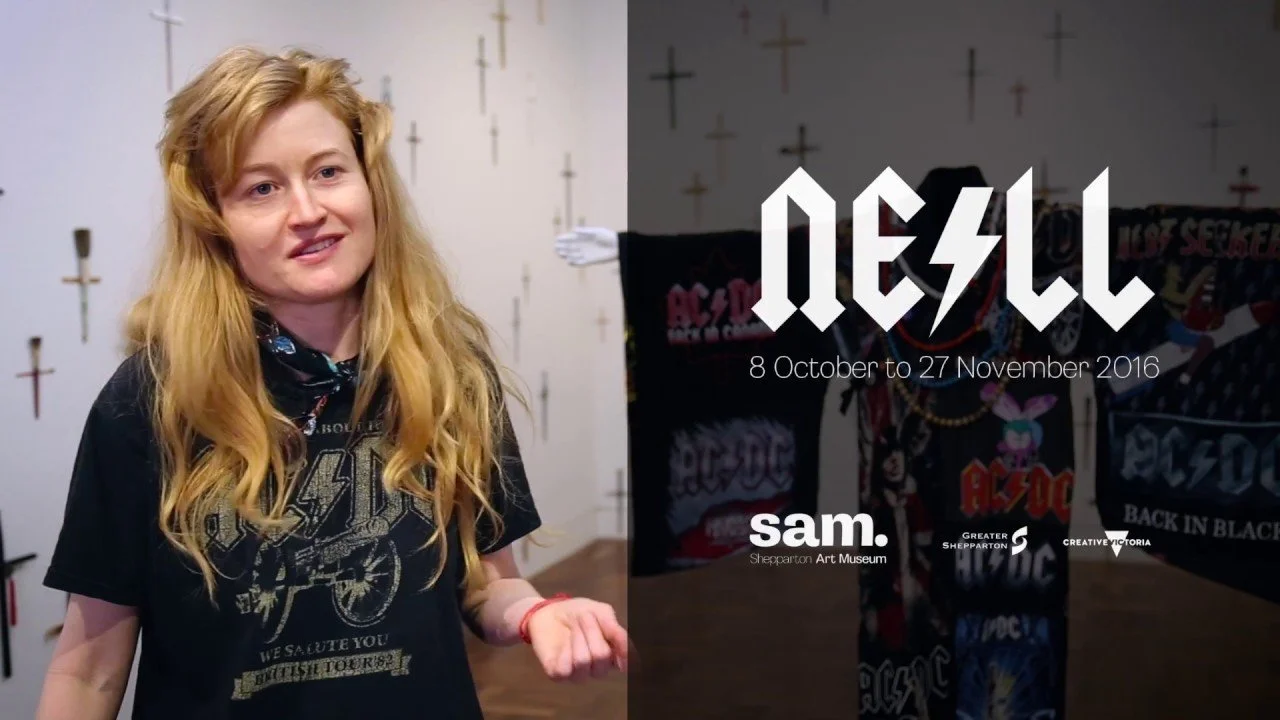
The Maitland raised, Sydney-based Nell opened her eponymous show at Shepparton Art Museum (SAM) last month.

Situated about two hours north-east of Melbourne, Shepparton is another regional town, like Maitland, best known for industry. Shepparton, however, has the distinction of hosting an early tour by the Australian rock band ACϟDC in 1976.

On the 40th anniversary of that gig, Nell’s debut survey show (an exposition on a specific theme) draws heavily upon the artist’s teenage worship of the iconic band.

Investigating the symbolism of spirituality, sexuality and rock-and-roll, NEϟLL – the show – is a startling, visceral journey utilising media including video, installation, painting and ceramics.

Nell explores universal themes and rituals familiar to the human experience – life, faith, grief, creation – through primitive, egg-like forms, ominous cenotaphs (inscribed with Biblical verse and song titles) and the tools of music making (drum sticks, guitar picks).

This powerful iconography evokes the cycle of life with a playful melancholy. Indeed, the gallery space encourages reverent contemplation, its starkly lit, interconnecting rooms suggestive of spaces for worship.

Nell’s installation The Wake, in particular, is a moving meditation on death and creation, utilising a collection of unique, egg shaped ceramic vessels known as Haniwa, or Japanese funerary objects. These memento mori – reminders of death – unsettle the viewer and encourage quiet reflection.

Elsewhere, Nell’s video work is more exuberant. In one piece, Fly as high as me, the artist assaults a giant fly with a cricket bat to the point of exhaustion. In another, Quiet/ Loud, she meditates on an amplifier while a female guitarist shreds noisily. In perhaps the most ambitious, Nell recreates and gender flips ACϟDC’s historic 1975 film clip It’s a Long Way To The Top (If You Wanna Rock And Roll).

Further exploring life’s binaries, installations of The Beatles’ White Album and ACϟDC’s Black Album are juxtaposed on opposing walls. Even the artist’s blackletter logo itself, split in two by a divine lightning bolt, suggests the duality of the human condition.

A neon-lit terrarium, Nell’s ‘Cabinet of Curiosities’– or Wunderkammer – entitled Some of the Things I Like, features works from SAM’s varied collection curated by the artist, including Canberra artist Heather B. Swann and emerging rock star sculptor Ramesh Nithiyendran.

Curated by SAM’s Rebecca Coates and Anna Briers, NEϟLL is laid out cyclically, transporting the viewer from space-to-space, each investigating an aspect of the artist’s eclectic practice.

The gallery’s high-ceilings evince sacred places. The work Let There Be Robe features a pile of plectrums/ communion wafers at its base and stands, arms outstretched, in a room decorated with crucifixes fashioned from drum sticks and paint brushes.

Exploring various forms of worship, belief and shared human experiences through an exciting range of media, NEϟLL is a powerful experience, at once raw, cathartic, warm and playful.

The exhibition itself and the museum’s diverse collection in general should be sufficient motivation for the art lover to make the sojourn north.
Highly recommended.

NEϟLL is showing until 27 November.

NEϟLL
Shepparton Art Museum
70 Welsford St Shepparton 3630
www.sheppartonartmuseum.com.au

Originally published here.

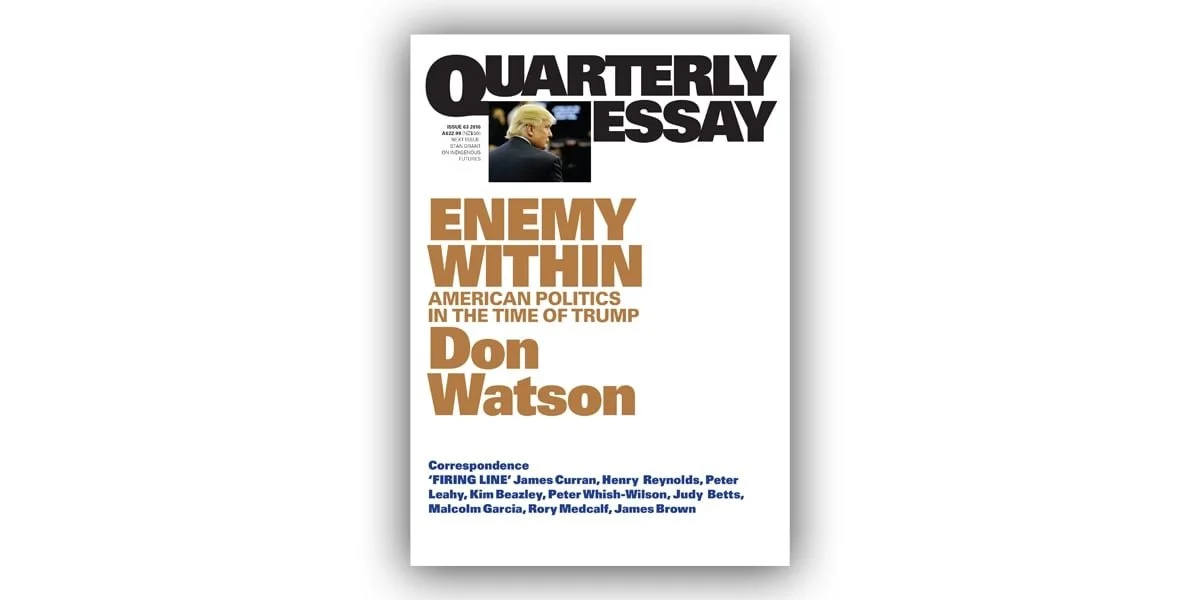
Don Watson: The Enemy Within by Garth Jones

AS the United States prepares to head to one of the most divisive Presidential polls in history, author and speechwriter Don Watson returns with his second Quarterly Essay.

Watson, a former speechwriter for Paul Keating, adopts a travelogue structure, similar to his 2008 book American Journeys. Travelling through the US interior, the author seeks to take the temperature of the state of the American body politic.

Reflecting on the toxic discourse of the 2016 election campaign, Watson discusses the roots of the United States’ historically unprecedented cultural and political division.

Enemy Within considers the three philosophical directions suggested by establishment candidate Hillary Clinton, social progressive Bernie Sanders and rogue Republican demagogue Donald Trump. Watson frames his musings around the concept of American Exceptionalism and the key role faith (in many guises) plays in presidential politics.

A lifetime political animal, the author attempts to parse the mythology and narratives of American public affairs which eventually spawned Donald Trump. The businessman, initially dismissed as a clownish sideshow, has, as of this writing, preyed on the electorate’s worst instincts and now seems within shouting distance of the White House.

Shrewdly exploiting a national sense of an Empire in decline, Trump’s populist ‘Make America Great Again’ narrative has thrived on fear mongering, xenophobia and paranoia.

Written before the Democratic and Republican National Conventions, where presidential nominees are anointed, Enemy Within is perhaps handicapped by the Quarterly Essay’s publishing schedule. Taking into consideration increasingly fraught opinion polling as election day draws nearer, it would be interesting to see a companion piece from Watson as the race tightens.

With November just around the corner, Watson’s essay serves as a fascinating insight into the historical and cultural forces behind the current parlous state of American presidential politics.

www.quarterlyessay.com

RRP: $22.99

Originally published here.

Faith in science by Garth Jones

In last June’s Crosslight, I reviewed Prof David Tacey’s Beyond Literal Belief: Religion As Metaphor. Tacey’s book characterised the Bible as ‘a tapestry of stories designed to challenge and enhance life’s meaning’. Tacey acknowledged the work of ‘fundamentalist atheists’ like Richard Dawkins and Christopher Hitchens as misapprehending the symbolic nature of faith in favour of literalism.

The latest in cultural historian Catherine M. Wallace’s Confronting Fundamentalism series, Confronting Religious Denial of Science explores similar notions of metaphor and symbolism in an attempt to reconcile the opposition between science and religion, which dates back to the Enlightenment.
As informed by the work of natural philosopher Isaac Newton, the Enlightenment framed God as the Engineer Almighty, orchestrating all earthly events. Wallace suggests that, when Frederich Neitzsche famously declared “God is dead”, he was actually referring to the death of moral absolutes as evolving scientific thinking rendered the Engineer Almighty concept redundant.

Citing anthropologist Clifford Geertz’s concept of religion as ‘an evolved disposition to create symbolic structures that motivate pro-social behaviours’, Wallace examines the ways in which this approach can help rationalise the contradictions between science and belief.

Championing an evolving, dynamic approach to scriptural engagement, Wallace suggests a humanist paradigm in which Christianity is eternally evolving “source code”, with the notion of “God as love” at its core. This approach allows science and religion to cohabit, while also trusting that logic would finally consign the regressive contradictory dogma of fundamentalist and far right biblical literalist thinking to the past.
This book is a slim tome, a series of vignettes designed to encourage further investigation and scholarship.

Steeped in approachable language, Wallace includes personal anecdotes to illustrate her thesis. The author has a frustrating tendency, however, to reference as-yet unpublished volumes, giving the impression of an incomplete work.

Passionately advocating for an embrace of humanism as Christianity’s primary ethos, Confronting Religious Denial of Science is a thought-provoking work which will increase in value as subsequent volumes are released.

Available at: morningstarpublishing.net.au. RRP:$21.95

Originally published here.

James Brown: Firing Line by Garth Jones

Si vis pacem, para bellum.’ (‘If you want peace, prepare for war’).

As a pacifist, I came to former Australian Army Officer James Brown’s Quarterly Essay with some measure of apprehension.

Brown, a veteran of the second Iraq War and Afghanistan, applies his rigorous knowledge of defence and military issues in this examination of Australia’s role in 21st century conflicts.

Firing Line, Australia’s Path To War advocates for a thoughtful approach to matters of national defence, and is an excellent primer on our country’s geopolitical responsibilities as a so-called ‘middle power’. The essay gives consideration to our national interest, framed against the backdrop of shifting global alliances, terrorism and the continued evolution of the technologies of war.

Sensitive to the horrors and trauma of war, Brown writes with admirable pragmatism on the realities of Australia’s place in the global hegemony in stark terms.

Firing Line also makes a clearheaded case for our staggering focus on defence spending. Even this skeptical reader finished the essay understanding, if not precisely convinced, of our government’s policies.

Brown also gives extensive consideration to the unprecedented powers of the Australian Prime Minister in matters of war, and wonders at the wisdom of this approach.

In the lead up to the 2016 Federal Election, whispers began of former Prime Minister Tony Abbott returning to the Turnbull Government’s ministry in the Defence portfolio.

Brown’s Quarterly Essay is an eloquent repudiation of the Member for Warringah’s qualifications and temperament, with quotes from Abbott’s March Quadrant essay, ‘I Was Right On National Security’ giving the reader particular cause for concern:

“Placing substantial numbers of Australian troops within twenty-five miles of a hostile Russian army was a scenario that no one had ever before contemplated,” Brown writes.

Brown’s tempered prose throws Abbott’s aggressive overreach into relief. Considered and never hawkish, Brown examines the realpolitik and outlines a pragmatic approach to policy and preparedness for future conflicts.

Firing Line, Australia’s Path To War is an illuminating, perceptive examination of Australia’s shifting strategic role in the new millennium, a measured education for hawk and dove alike.

Originally published here.

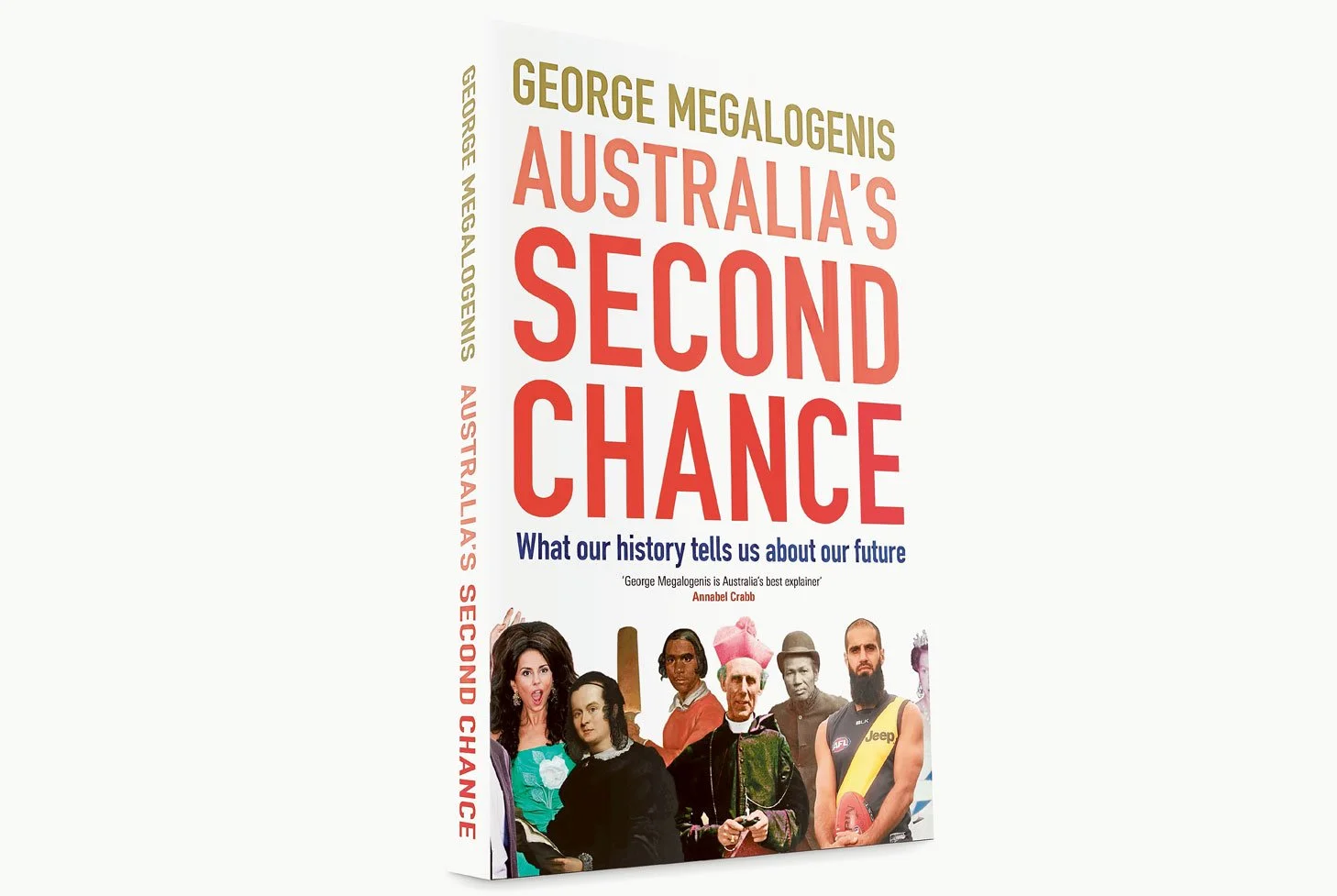
George Megalogenis: Australia’s Second Chance by Garth Jones

Australia’s Second Chance is former Canberra press gallery journalist and newspaper columnist George Megalogenis’ second excursion into the rough tapestry of our national identity.

Megalogenis’ first book, The Australian Moment, explored the unique political, social and economic circumstances that led to the nation surviving the Global Financial Crisis.

Continuing that line of investigation, Australia’s Second Chance delves into our migrant past, present and future, examining the advantages our history and wealth (environmental/ fiscal) afford us.

The Australian Moment was framed from Megalogenis’ perspective as a first generation Australian, and thus concerned primarily with events from the Whitlam era onwards.

This new work widens the author’s focus, examining the first encounters between Aboriginal Australia and the First Fleet through to the contemporary national conversation.

Megalogenis is concerned with charting the peaks and troughs of our growth and confidence, highlighting the rich contributions of multicultural Australia.

Contrasting our inherent egalitarian nature with our sometimes quixotic, isolationist tendencies, Megalogenis illustrates that our finest moments are characterised by our capacity to share.

Approachable, engaging and illuminating, Australia’s Second Chance combines history, dry economic data and political acumen informed by Megalogenis’ decade at the Canberra coal-face. In a sometimes grim zeitgeist, Australia’s Second Chance offers a hopeful blueprint for a brighter future by shining a light on our adventurous, creative and somehow more inclusive past.

Originally published here.