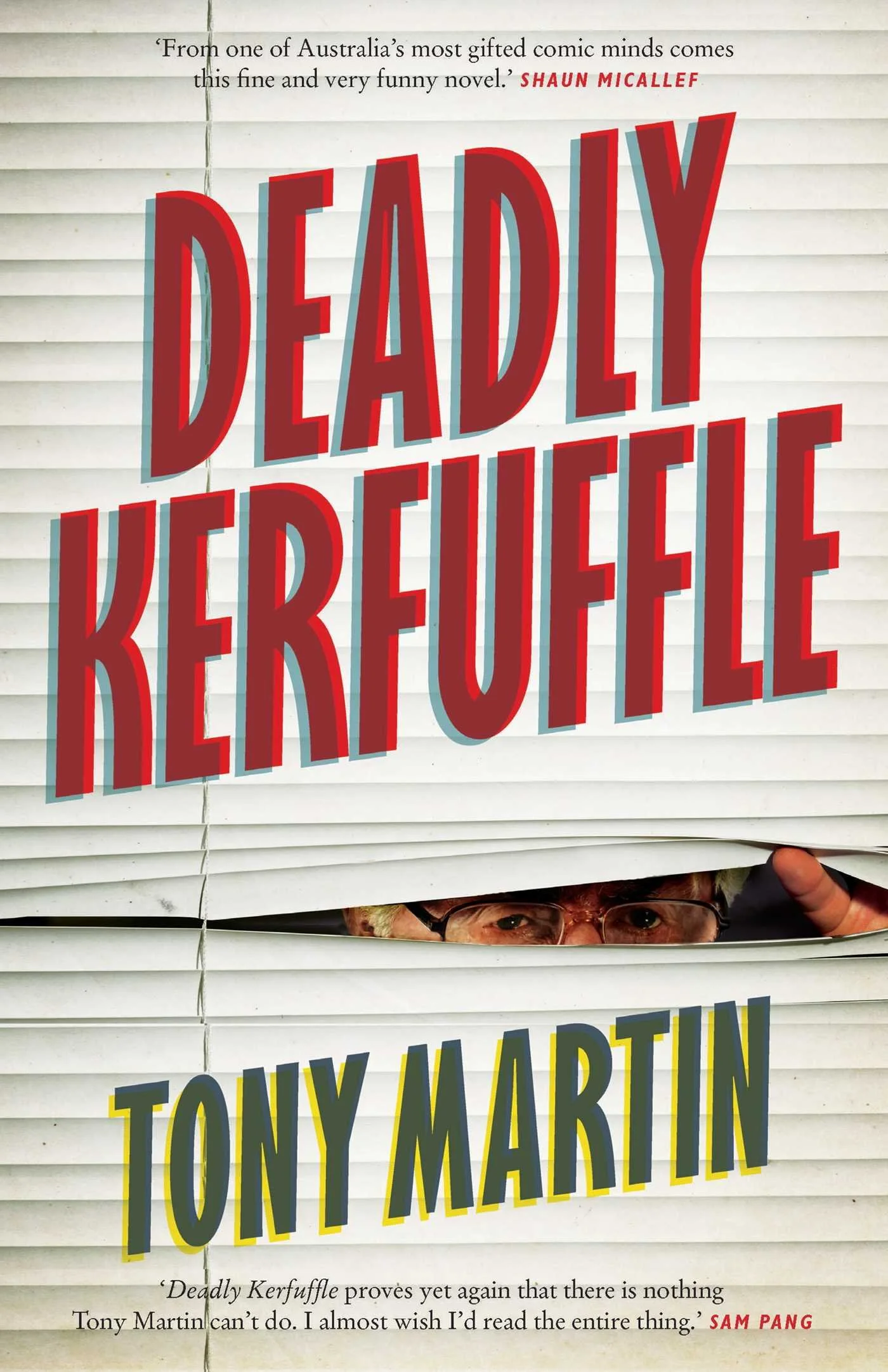
Tony Martin’s DEADLY KERFUFFLE by Garth Jones

CAST your mind back to 2006.

The Australian twenty four hour news cycle was in its infancy - scuttlebutt, innuendo, hearsay, grossly ill-informed speculation and flat out bullshit travelled at much slower speeds.

It was a gentler, simpler time of Blackberrys, Sky News and anti-terror fridge magnets.

Terrestrial television, talkback radio and tabloid newspapers were still the preferred delivery methods for half baked dog whistling and racist paranoia - Twitter and Facebook were years from hitting their straps in any meaningfully awful, democracy endangering way.

Fake News – AKA spurious bunkum–  was what you heard over the back fence from your gossipy neighbour, or over a few pints from the dotty old racist down the local.

Viewed in the rear-view mirror from here in bad old dystopian 2017, 2006 has almost acquired a warm, nostalgic glow. Even the Howard Government looks vaguely – vaguely –  palatable from this historical angle.

Believe it or not, that was all a mere decade ago.

Tony Martin’s career has thus far spanned four decades.

From his early days with The D-Generation and The Late Show, through film (Bad Eggs), popular commercial radio stints (Triple M’s Martin/ Molloy, Get This) and a return to the ABC (Upper Middle Bogan), Martin’s comedy has long been attuned to the art of gently pulling the piss out of day to day Aussie mundanity.

Deadly Kerfuffle, Martin’s debut novel, leans heavily on the Kiwi author’s keenly observed insights into the sinister flip side of our daggy national character.

Lifting directly from the cover blurb:

“It’s 2006, and terror scaremongering in the media has rattled the residents of sleepy, suburban Dunlop Crescent. When a Maori family moves into number 14, the local cranks assume they are Middle Eastern terrorists hell-bent on destroying the Australian way of life. Rumour has it that they plan to turn their house to face Mecca...”

Events spin madly out of control – as they’re wont to do – when pompous radio shock jocks, fedora sporting conspiracy theorists, cable news muckrakers, hysterical tabloid newspaper coverage and bumbling national security apparatchiks quickly turn a bit of benign cul-de-sac pensioner bigotry into a potential terrorist event.

Sounding all-too eerily plausible?

With an insider’s ear for the local media industry, Deadly Kerfuffle wrenches back the curtains on the sordid inanity of Melbourne’s rampant pundit class, throwing particularly dense shade at certain overly familiar personalities from the right wing nut job commentariat.

Deadly Kerfuffle’s plot – driven by mistaken identities and escalating farce – nods to Martin’s cinephilia. There’s a healthy dash of film noir via Coen Brothers quirk inherent in the book’s intertwining, pulp novel narrative beats, and the seedy cast of oddballs is fleshed out with bumbling twits, scheming egomaniacs with half-arsed schemes and some all-too believable Nazi thugs.

Martin’s keen eye (and ear) for trenchant detail – note the author’s obvious affection for the quaint anachronisms of mainstream Aussie culture – permeate Deadly Kerfuffle. Melburnians in particular will revel in Martin’s sense of place – dramatic hostage scenes play out in the absurdly appointed confines of an extinct theatre restaurant, and elsewhere some of St Kilda Road’s more naff “iconic” architecture is treated with the contempt it invites.

Deadly Kerfuffle is, to engage dual critical clichés, a laugh-out-loud funny page-turner. Martin’s affable literary voice makes this a jovial holiday read, while darker truths bubble at the fringes of this amiable tale of radicalised OAPs and outsized egos.

Having shrewdly set his first novel in our recent past, one wonders what accelerated horrors would beset Martin’s protagonists were it to have been set in the present day?
Helen Razer’s Total Propaganda by Garth Jones

EIGHT rich, old, white dudes control more wealth than the poorest 50% of people on planet Earth.

That’s a depressingly slight percentage of the vaunted 1% which benefited from the Global Financial Crisis (GFC) and birthed the Occupy movement.

As global inequality has intensified in the decade since the GFC, the shock of the decline of Capitalism has given rise to Trumpism, Brexit and the re-emergence of fascist politics.

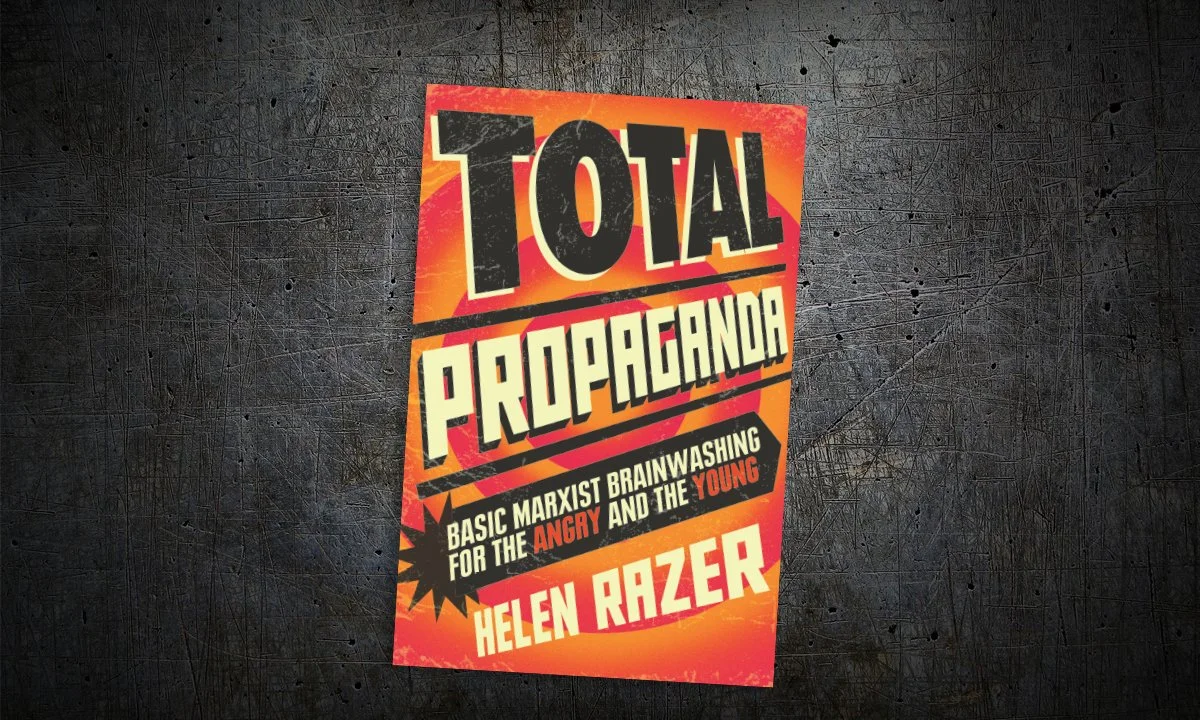
Helen Razer’s Total Propaganda: Basic Marxist Brainwashing for the Angry and the Young poses the question: surely a better, more equitable alternative exists?

Razer – a Gen X figurehead whose punk ethos defined Triple J radio for a generation of ‘90s kids – is today an author, Crikey columnist and cranky public intellectual.

She’s also a proud, self-described Marxist.

Karl Marx, the revolutionary German political theorist and economist, was a nineteenth century critic of Capitalism and the father of Communism.

Taking a cue from her Millennial readers’ online intrigue, Razer has producedTotal Propaganda, a handy primer on Karl Marx’ ideas intended to inspire activism in a new generation of workers.

With a professorial zeal for clear explanation of dense economic, philosophical and cultural concepts, Total Propaganda zips succinctly from industrial revolution to GFC and beyond.

Razer unpacks automation, neoliberalism, the offshoring of manufacturing and the exploitation of the global south using a curt turn of phrase and direct language. The author also nods to the popularity of Jeremy Corbyn and Bernie Sanders – two woolly headed old white dudes espousing Marxist ideas – with Millennial voters.

Total Propaganda: Basic Marxist Brainwashing for the Angry and the Young is brisk, often hilarious, and most importantly educational read for anyone intimidated by the language of class, political theory and economics.

Razer’s book is an excellent jumping off point for further reading in the field, and includes a comprehensive further reading section including links to all of Marx’ writings, which now live in the public domain and are available online.

Total Propaganda: Basic Marxist Brainwashing for the Angry and the Young is out now.

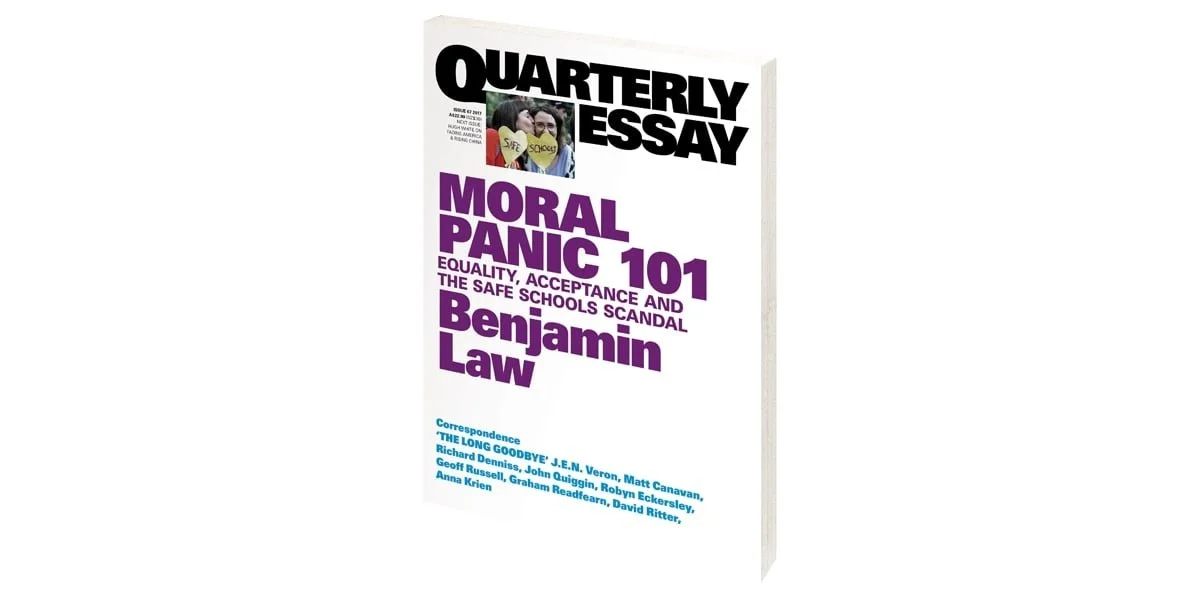
Benjamin Law’s Moral Panic 101 by Garth Jones

AS I prepare this review, the Coalition government’s same-sex marriage postal survey is entering its second week.

The Australian Christian Lobby, led by Lyle Shelton, is presently staging a ‘no’ campaign launch in Adelaide, the City of Churches.

A quick scan of my - or anyone else’s - social media feed is more than enough to confirm that Prime Minister Malcolm Turnbull’s promise of a “respectful debate” on same sex marriage is naive whimsy, at very best.

We are just seven days into a two-month process, and it is sadly evident that a festering national wound has been opened. Hysterical misinformation and threats of violence permeate the print and online sphere - a relentless march of jaundiced think-pieces and partisan dog whistling.

It is hard to imagine journalist and author Benjamin Law’s Quarterly Essay #67, Moral Panic 101, arriving at a more socially and historically apt time.

Moral Panic 101 forensically deconstructs the unhinged response - dare I say it, the ‘Fake News’ - deployed by the Murdoch press and some right wing Christian groups in relation to the Safe Schools program.

Safe Schools - ironically an Abbott government initiative - was subject to a scare campaign which, it is now apparent, provided the broader, twisted blueprint for the present ideological trench warfare being conducted over same sex marriage.

Law, an LGBTIQ Asian-Australian, empathetically relates the deeply traumatic consequences of this negative, ugly campaigning on the school children impacted.

Safe Schools, a program intended to provide 21st century appropriate sex education to kids across the gender attraction and identification spectrum, was quickly hijacked by the petty, culture warrior agenda of Australia’s self-designated guardians of conservative morality.

Moral Panic 101 illustrates the heavy burden of this demagogic cane waving.

Law’s essay is a sad litany of traumatised queer kids’ lives ruined, and in some cases cut short, by bigotry, ignorance and political point scoring.

Of course, when such a low rhetorical bar is being set by politicians and figures in our news media, what hope does ‘respectful debate’ actually have?

Transposing the ugly battlelines drawn over the mental health of children, we are now confronted with the very real ramifications of the rhetorical escalation of conservative Australia over the right for same sex couples to marry with equal rights.

If the reaction of the Murdoch press is anything to go by, Moral Panic 101 has certainly poked a conservative nerve.

Sadly, Law’s essay - in daring to question the relevance and reach of the agenda-driven tabloid morals campaigners in Mr Murdoch’s employ - has triggered an aftershock of moral panic over Law’s social media usage among those unfamiliar with the ironic vernacular of the online sphere.

It is here that at the precipice that Law’s essay -  a class in lucid, careful journalism - presently teeters.

If you’re yet to return your same-sex marriage survey, and are perhaps conflicted (they need to be in the mail by October 27) I urge you to search out Law’s timely and essential essay.

We stand at the precipice of an important, defining schism in the fabric of Australian society in the early 21st century.

As Victorian Premier Daniel Andrews pointed out in a tweet in early September, US television comedy The Golden Girls had the last word on marriage equality during the first Bush Presidency:

“Everyone wants someone to grow old with... and shouldn’t everyone have that chance?”

David Marr: The White Queen by Garth Jones

IN his seventh Quarterly Essay, The White Queen - One Nation and the Politics of Race, journalist David Marr examines Pauline Hanson and One Nation’s re-emergence in our current global political context.

Collaborating with a team of statisticians, Marr analyses the resurgence of Hanson through the lens of Australian voters’ demographic makeup.

One Nation’s rise itself is investigated through an exploration of PM John Howard’s mid-late 1990s political opportunism, providing an illuminating timeline of Hanson’s hot button topics. Muslims, for one, have obviously replaced Asians as our nation’s greatest existential threat.

Marr discussed The White Queen at Carlton’s Church of All Nations in late March, noting that his work can be robbed of topicality by the rapid pace of modern political theatre. In June 2010, soon to be ex-Prime Minister was in his sights. ‘Political Animal’, Marr’s piece on then Opposition Leader Tony Abbott, arrived in late 2012, just months before the ouster of Julia Gillard and the doomed return of Rudd.

Released on 27 March, The White Queen was published in the wake of the Western Australian state election. Then Liberal Premier Colin Barnett had engineered preference deals with One Nation, which backfired spectacularly and led to – for the Liberal Party – an ominous electoral wipeout.

In the current edition of The Monthly, journalists George Megalogenis and Richard Cooke also reflect on One Nation’s constituents steadily eroding the Liberal Party’s traditional voter base.

This explains the Turnbull Liberal Government’s further push to the populist right. The recent abolition of certain 457 Visas subtly dog-whistle to Hanson’s base and are met with approval from Hanson herself. Bill Shorten’s Labor Opposition – hardly immune to criticism – has also embraced Trumpian ‘nation first’ rhetoric in an effort to woo disaffected middle Australian voters.

As noted, the frenzied pace of modern political discourse renders any printed work fleetingly contemporaneous. Regardless, Marr’s newest Quarterly Essay provides us with a useful snapshot of the present condition of mainstream Australia, and is recommended for those critical insights alone.

Originally published here.

Knocking religion: The Book of Mormon by Garth Jones

RELIGIOUS satire has existed for millennia, pre-dating Christianity itself.

From the work of Greek playwright Aristophanes - circa 400BC -  through to last year’s ribald Seth Rogen animated comedy Sausage Party, the tradition of art questioning belief is fundamental to humanity’s ongoing spiritual evolution.

In his 2003 book A Serrated Edge: A Brief Defense of Biblical Satire, theologian Douglas Wilson reminds us that “satire is a kind of preaching… Satire treats the foibles of sinners with a less than perfect tenderness.”

Trey Parker and Matt Stone, of South Park notoriety, have ribbed religion since their early animated short, 1992’s ‘Jesus versus Frosty’. The duo could certainly be accused of “less than perfect tenderness” when it comes to their wide-ranging satirical targets. No cow is too sacred for these equal opportunity provocateurs - race, sexuality, popular culture and religion are all fair game, with everyone from bleeding hearts to conservative hard liners squarely in their sights.

The Book of Mormon - developed by Parker and Stone with Grammy-winning Avenue Q songwriter Robert Lopez - debuted on Broadway in 2011 to astonishing, ongoing success.

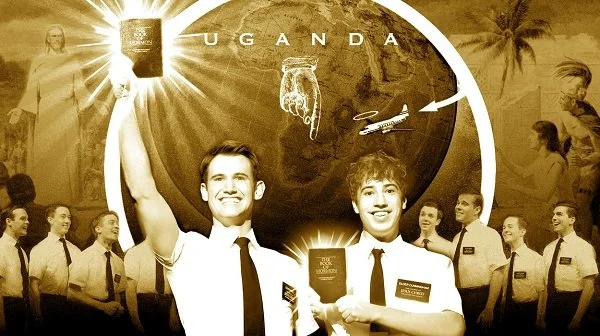
The story of two trainee Mormon missionaries - the ambitious, benignly ruthless Elder Price (Canadian Ryan Bondy channelling Trump offspring Eric) and the dorky, lonely Elder Cunningham (Broadway production transplant A.J. Holmes) - Book of Mormon continues the South Park creators’ career-long obsession with profane parody, the overblown tropes of musical theatre and ever-present scatological provocation.

The Book of Mormon follows Elders Price and Cunningham’s unexpected two year deployment to Uganda. Confronted with Third World realities - AIDS, ruthless warlords, female genital mutilation, extreme poverty - the duo of innocent Latter-Day Saints discover these issues are not easily resolved with homilies or rituals.

Drawing upon the extravagant staging, religious motifs and rock opera excesses of Tim Rice and Andrew Lloyd-Webber’s Joseph and His Amazing Technicolour Dreamcoat (1968) and Jesus Christ Superstar (1971), The Book of Mormon also expands upon themes explored in Monty Python’s notoriously banned Life of Brian (1978).

Melbourne’s Princess Theatre plays host to the debut southern hemisphere staging of The Book of Mormon. Showcasing an ensemble equal parts local and international, those familiar with the Broadway Cast Recording will be pleased to hear that all of the show’s rousing anthems, pin-drop balladry, fist-pumping reprises and riff-driven rock tunes are presented in exuberantly rude health.

With emphasis on the rude.

Similarly, The Book of Mormon’s choreography, production and sound design are mesmerising, at once lampooning more straight-laced musical theatre fare and simultaneously exalting in its traditions.

Without ruining The Book of Mormon’s many narrative and musical surprises, rest assured you’ll bear witness to:

  • Take-away coffee cups engaged in Busby Berkeley style dance numbers amidst crimson hellscapes

  • Pastel, Norman Rockwell inspired reenactments of Latter Day saint founder Joseph Smith discovering the Golden Plates, the basis of Smith’s Book of Mormon, in New York (circa 1823)

  • A raunchy, Disney-inspired showstopper that will leave you gasping (with laughter or outrage)

Admittedly, that’s barely scratching the surface of Parker and Stone’s latest subversive paean to the musical theatre form, another gleeful example of these naughty little boys’ scorched earth, defiantly politically incorrect stage and screen output.

As Douglas Wilson reminds us, “satire pervades Scripture”. The Book of Mormon, with a wicked gleam in its eye, challenges us to open ourselves to Parker and Stone’s parodic fable and its confronting reflections on the role of mainstream religion in an increasingly troubled world.

Preview a track from the Original Book of Mormon Broadway Cast Recording here.

Original review published here.

On The Origins of Art - MONA by Garth Jones

To paraphrase Monty Python’s Life of Brian, MONA Museum figurehead David Walsh is not the art world’s Messiah, he’s just a very naughty boy.
The quirky Tasmanian gambler, art collector and businessman – obsessed with sex, death and viscera – challenged four scientist colleagues to curate exhibitions showcasing their theories On The Origin Of Art.

In an effort, perhaps, to foment a little more outrage, Walsh – a noted contrarian – has chosen ‘experts’ who are all distinctly male, white and middle-aged.

The exhibition is arranged as a series of four portals, each leading to an individual curator’s vision of creative genesis, marked with an arcane glyph drawn from the exhibition’s catalogue for added portent.

Steven Pinker, a North American psychology professor and experimental psychologist, asserts that ‘We Make Art Because We Can’. Pinker asserts that art evolves in step with our innate desire to identify as part of a ‘fashionable elite’ – his portion of the show revels in elaborate wallpapers, ornate jewellery and new media installations.

Evolutionary neurobiologist and cognitive scientist Mark Changizi wonders ‘Does Civilisation Mimic Biology?’ Changizi’s thesis is that culture instinctually harnesses nature – through design, music and language – to allow us to evolve and engage with others. Showcasing many tactile, sculptural disciplines, Changizi’s collection is rooted in the fleshy, biological imagery of laboratory slides and abattoirs, paying particular attention to Australian artist Patricia Piccinini.

English Professor Brian Boyd explores the ideas behind ‘Art Is Cognitive Play With Pattern’. Boyd suggests that art evolved through humanity’s need to communicate complex concepts through pattern in an effort to better understand the world around it. Boyd explores these notions through patterns in nature and forms of religious worship. He also pays special attention to sequential art and the chilling allegorical depictions of Nazi Germany starkly rendered by Pulitzer Prize winning graphic novelist Art Spiegelman.

Perhaps most provocative is American psychology professor Geoffrey Miller, whose ‘Artists Are Sexy AF’ guides the viewer through a rollercoaster of visual stimuli, from the classical to the tawdry to the pornographic. Miller submits that art is another form of metaphorical plumage designed to secure a mate through a display of desirable technical aesthetic virtuosity. Illustrating his point, Miller includes lurid work by pop artist Jeff Koons alongside reflections on insect mating rituals and 19th century romantic portraiture.

You may agree or disagree with some, or all, of the notions put forth by Walsh’s coterie of agitators – On The Origin of Art is a stirring exhibition in terms of variety, philosophy and sheer volume of work on display. Walsh’s newest offering asks us to investigate ideas of the very origins of our humanity, be they creative, spiritual, biological or other.

Opening last year on 5 November to bustling crowds, On The Origin Of Art is an ambitious achievement of art curation, collection and exhibition.
A thought-provoking journey guaranteed to generate passionate debate, this experience can’t come more highly recommended.

Originally published here.

Highway To Nell by Garth Jones

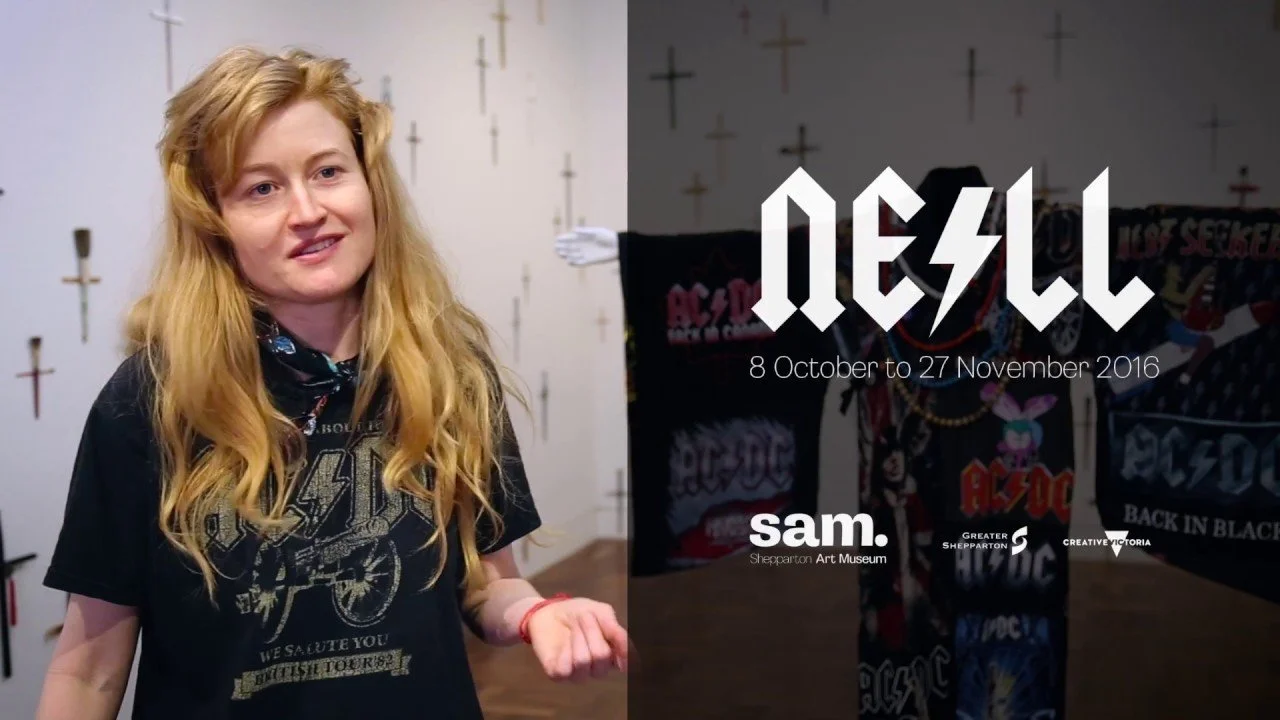
The Maitland raised, Sydney-based Nell opened her eponymous show at Shepparton Art Museum (SAM) last month.

Situated about two hours north-east of Melbourne, Shepparton is another regional town, like Maitland, best known for industry. Shepparton, however, has the distinction of hosting an early tour by the Australian rock band ACϟDC in 1976.

On the 40th anniversary of that gig, Nell’s debut survey show (an exposition on a specific theme) draws heavily upon the artist’s teenage worship of the iconic band.

Investigating the symbolism of spirituality, sexuality and rock-and-roll, NEϟLL – the show – is a startling, visceral journey utilising media including video, installation, painting and ceramics.

Nell explores universal themes and rituals familiar to the human experience – life, faith, grief, creation – through primitive, egg-like forms, ominous cenotaphs (inscribed with Biblical verse and song titles) and the tools of music making (drum sticks, guitar picks).

This powerful iconography evokes the cycle of life with a playful melancholy. Indeed, the gallery space encourages reverent contemplation, its starkly lit, interconnecting rooms suggestive of spaces for worship.

Nell’s installation The Wake, in particular, is a moving meditation on death and creation, utilising a collection of unique, egg shaped ceramic vessels known as Haniwa, or Japanese funerary objects. These memento mori – reminders of death – unsettle the viewer and encourage quiet reflection.

Elsewhere, Nell’s video work is more exuberant. In one piece, Fly as high as me, the artist assaults a giant fly with a cricket bat to the point of exhaustion. In another, Quiet/ Loud, she meditates on an amplifier while a female guitarist shreds noisily. In perhaps the most ambitious, Nell recreates and gender flips ACϟDC’s historic 1975 film clip It’s a Long Way To The Top (If You Wanna Rock And Roll).

Further exploring life’s binaries, installations of The Beatles’ White Album and ACϟDC’s Black Album are juxtaposed on opposing walls. Even the artist’s blackletter logo itself, split in two by a divine lightning bolt, suggests the duality of the human condition.

A neon-lit terrarium, Nell’s ‘Cabinet of Curiosities’– or Wunderkammer – entitled Some of the Things I Like, features works from SAM’s varied collection curated by the artist, including Canberra artist Heather B. Swann and emerging rock star sculptor Ramesh Nithiyendran.

Curated by SAM’s Rebecca Coates and Anna Briers, NEϟLL is laid out cyclically, transporting the viewer from space-to-space, each investigating an aspect of the artist’s eclectic practice.

The gallery’s high-ceilings evince sacred places. The work Let There Be Robe features a pile of plectrums/ communion wafers at its base and stands, arms outstretched, in a room decorated with crucifixes fashioned from drum sticks and paint brushes.

Exploring various forms of worship, belief and shared human experiences through an exciting range of media, NEϟLL is a powerful experience, at once raw, cathartic, warm and playful.

The exhibition itself and the museum’s diverse collection in general should be sufficient motivation for the art lover to make the sojourn north.
Highly recommended.

NEϟLL is showing until 27 November.

NEϟLL
Shepparton Art Museum
70 Welsford St Shepparton 3630
www.sheppartonartmuseum.com.au

Originally published here.